FOR RESIDENTIAL & COMMERCIAL
Flat & Low-Slope Roofing in the Chicago suburbs & Southern Wisconsin
Lakeland’s flat roofing foremen each have over 35 years of experience working on both residential flat sections and full commercial roof systems throughout Chicago suburbs and Southern Wisconsin.

-
 Certified Applicator, Commercial Innovations Roofing & Waterproofing Systems
-
 50-Year Material Warranty · 10-Year Workmanship Warranty
-
 5.0 across 240+ reviews
Residential Flat Roofing
Not every flat roofing job is a commercial building. Many homes in the Chicago suburbs have flat or low-slope sections: a detached garage, an addition built off the back of the house, a sunroom, or a low-slope transition connecting two roof planes. These sections fail differently than pitched roofing and need a contractor who understands the specific installation requirements for low-slope residential work.
Flat garage roofs are one of the most common residential flat roofing calls we receive. EPDM and modified bitumen are the most frequent specifications for detached garages: both are well-suited to the scale, handle temperature cycling reliably, and last 20–30 years when installed correctly. Poor drainage is the most common cause of premature failure. We assess the deck condition, correct any drainage issues, and install the right system for the structure.
When a home addition or sunroom is built with a flat or low-slope roof, the junction between the flat section and the existing pitched roof is a critical flashing point. Water management at that transition determines whether the addition stays dry for 20 years or becomes a chronic leak problem within five. Lakeland handles both the membrane installation and the transition flashing as a complete scope, not two separate jobs.
Residential Flat & Low-Slope Roofing
Not every flat roofing job is a commercial building. Many homes in the Chicago suburbs have flat or low-slope sections: a detached garage, an addition built off the back of the house, a sunroom, or a low-slope transition connecting two roof planes. These sections fail differently than pitched roofing and need a contractor who understands the specific installation requirements for low-slope residential work.
Flat Garages & Detached Structures
Flat garage roofs are one of the most common residential flat roofing calls we receive. EPDM and modified bitumen are the most frequent specifications for detached garages: both are well-suited to the scale, handle temperature cycling reliably, and last 20–30 years when installed correctly. Poor drainage is the most common cause of premature failure. We assess the deck condition, correct any drainage issues, and install the right system for the structure.
Home Additions, Sunrooms & Low-Slope Sections
When a home addition or sunroom is built with a flat or low-slope roof, the junction between the flat section and the existing pitched roof is a critical flashing point. Water management at that transition determines whether the addition stays dry for 20 years or becomes a chronic leak problem within five. Lakeland handles both the membrane installation and the transition flashing as a complete scope, not two separate jobs.
Commercial Flat Roofing Services
Whether you’re roofing a new commercial build or replacing a system at end of life, Lakeland handles the full scope: tear-off (where required), deck inspection and remediation, insulation, membrane, flashing, drainage, and coping. Every installation is documented and submitted to the manufacturer for warranty registration before final invoice.
Flat roof failures don’t wait for business hours. Lakeland provides commercial flat roof repairs for leaks, seam failures, flashing separations, and storm damage. For active leaks causing business disruption, we respond with emergency tarping and temporary protection to limit interior damage while permanent repairs are scheduled.
For flat roofs that are structurally sound but losing performance, a coating system can extend service life by 10–15 years at a fraction of replacement cost. Coatings also improve energy performance through reflective surface treatments. Lakeland evaluates coating eligibility as part of every commercial assessment.
New Installation & Full Replacement
Whether you’re roofing a new commercial build or replacing a system at end of life, Lakeland handles the full scope: tear-off (where required), deck inspection and remediation, insulation, membrane, flashing, drainage, and coping. Every installation is documented and submitted to the manufacturer for warranty registration before final invoice.
Repair & Emergency Response
Flat roof failures don’t wait for business hours. Lakeland provides commercial flat roof repairs for leaks, seam failures, flashing separations, and storm damage. For active leaks causing business disruption, we respond with emergency tarping and temporary protection to limit interior damage while permanent repairs are scheduled.
Roof Coating Applications
For flat roofs that are structurally sound but losing performance, a coating system can extend service life by 10–15 years at a fraction of replacement cost. Coatings also improve energy performance through reflective surface treatments. Lakeland evaluates coating eligibility as part of every commercial assessment.
OUR SERVICES
Commercial Roofing Systems We Install
TPO (Thermoplastic Polyolefin) is the most widely specified single-ply commercial roofing membrane for good reason: it performs well in both heat and cold, reflects UV radiation to reduce cooling loads, and when installed correctly — with heat-welded seams — delivers watertight performance for decades.
EPDM (Ethylene Propylene Diene Monomer) is a synthetic rubber membrane with a long track record on commercial and industrial roofs. It’s particularly well-suited to large roof areas, extreme temperature swings, and buildings where long-term low-maintenance performance is the priority.
PVC (Polyvinyl Chloride) membrane roofing offers excellent chemical resistance and is a strong choice for commercial kitchens, food processing facilities, and properties with rooftop equipment that exhausts grease or chemicals. Like TPO, PVC seams are heat-welded, producing a monolithic waterproof surface across the full roof plane.
Modified bitumen is a multi-ply asphalt-based system that delivers the redundancy of built-up roofing in a more efficient installation format. It performs well on roofs with heavy foot traffic or mechanical equipment exposure, and is commonly used for re-roofing over existing substrates where a full tear-off isn’t warranted.
Built-up roofing — alternating layers of bitumen and reinforcing fabric — is one of the most proven commercial roofing systems available. BUR excels in durability, redundancy, and fire resistance, and remains the specification of choice for certain property types and building codes. Lakeland’s commercial team has decades of experience with BUR installations on both new construction and replacement projects.
TPO (Single-Ply Membrane Roofing)
TPO (Thermoplastic Polyolefin) is the most widely specified single-ply commercial roofing membrane for good reason: it performs well in both heat and cold, reflects UV radiation to reduce cooling loads, and when installed correctly — with heat-welded seams — delivers watertight performance for decades.
EPDM (Single-Ply Membrane Roofing)
EPDM (Ethylene Propylene Diene Monomer) is a synthetic rubber membrane with a long track record on commercial and industrial roofs. It’s particularly well-suited to large roof areas, extreme temperature swings, and buildings where long-term low-maintenance performance is the priority.
PVC (Single-Ply Membrane Roofing)
PVC (Polyvinyl Chloride) membrane roofing offers excellent chemical resistance and is a strong choice for commercial kitchens, food processing facilities, and properties with rooftop equipment that exhausts grease or chemicals. Like TPO, PVC seams are heat-welded, producing a monolithic waterproof surface across the full roof plane.
Modified Bitumen Roofing
Modified bitumen is a multi-ply asphalt-based system that delivers the redundancy of built-up roofing in a more efficient installation format. It performs well on roofs with heavy foot traffic or mechanical equipment exposure, and is commonly used for re-roofing over existing substrates where a full tear-off isn’t warranted.
Built-Up Roofing (BUR)
Built-up roofing — alternating layers of bitumen and reinforcing fabric — is one of the most proven commercial roofing systems available. BUR excels in durability, redundancy, and fire resistance, and remains the specification of choice for certain property types and building codes. Lakeland’s commercial team has decades of experience with BUR installations on both new construction and replacement projects.
Flat Roofing Systems We Install
The right flat roofing system depends on your property’s structure, use, drainage, budget, and long-term goals.
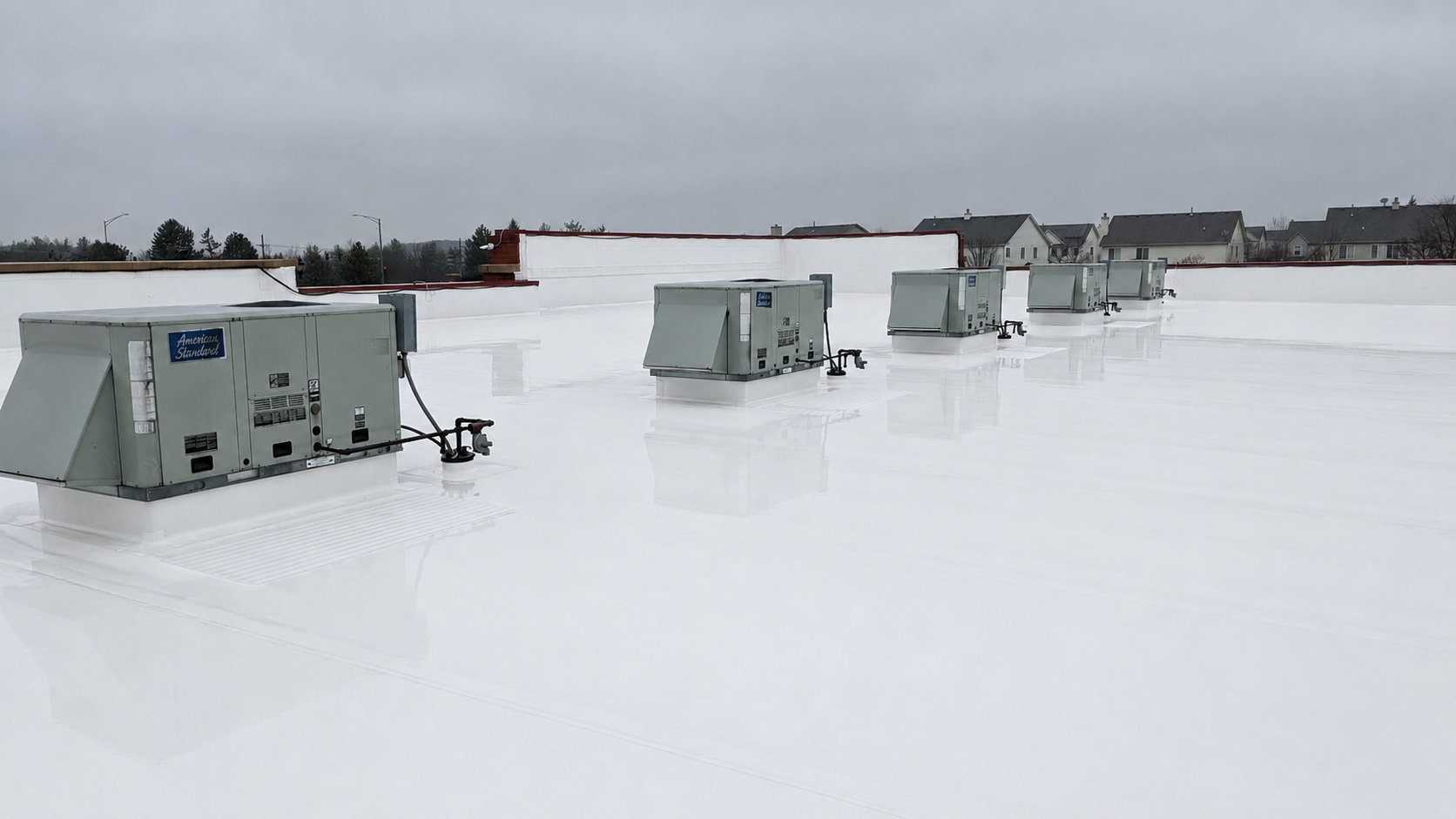
TPO Membrane Roofing
- Lakeland TPO installations include:• mil TPO membrane, fully adhered
- All seams heat-welded to manufacturer specifications
- R-30 PolyIso insulation, tapered for positive drainage, staggered-seam installation
- 1/2″ Glass Mat Sheathing Cover Board over insulation
- All pipe stacks, rooftop units, skylights, and penetrations flashed watertight
- New drain inserts for rooftop drains, flashed watertight
- 24-gauge factory-painted coping metal on parapet walls
- Bilco roof hatches with ladders (where specified)
- Scuppers, overflow scuppers, and downspouts
- TPO walkway rolls/pads at rooftop equipment access points
EPDM Membrane Roofing
- EPDM (Ethylene Propylene Diene Monomer) is a synthetic rubber membrane with a track record of 30+ year service life and one of the most common materials on both residential flat sections and large commercial roofs.nhandles extreme temperature cycles and UV exposure particularly well
- For residential applications such as flat garages, low-slope additions, and sunroom roofs, EPDM is often the right specification: flexible, durable, and proven in Midwest conditions.
Swift Start Starter Course
- PVC (Polyvinyl Chloride) membrane roofing is the specification of choice where chemical resistance matters: commercial kitchens, food processing facilities, and industrial properties with rooftop exhaust.
- PVC seams are heat-welded like TPO, producing a continuous waterproof membrane even at penetrations and field seams.
Modified Bitumen Roofing
- Modified bitumen is an asphalt-based multi-ply system with built-in redundancy.
- Strong choice for re-roofing over existing substrates, high-traffic commercial roofs, and residential applications where a more rigid system is preferred over single-ply membrane.n
Built-Up Roofing (BUR / Tar & Gravel)
- Built-up roofing (alternating plies of bitumen and reinforcing fabric, finished with aggregate surfacing) is one of the most durable and proven commercial roofing systems available.
- BUR delivers redundancy, fire resistance, and long-term performance, and remains the code-required specification for certain commercial building types and jurisdictions.n
Our Superior Warranty Coverage
Commercial installations:
On qualifying commercial flat roofing installations, Lakeland offers a 20-Year NDL (No Dollar Limit) Manufacturer Warranty. There is no cap on what the manufacturer will pay to repair or replace a failed system during the warranty period.
Lakeland pairs that with its own 20-Year Warranty covering Labor, Materials & Workmanship, a separate, standalone guarantee on our installation.
Residential flat roofing
Residential flat roofing installations are backed by Lakeland’s workmanship warranty. Warranty terms vary by system and scope. We’ll specify the applicable warranty coverage in writing before any work begins.
Licensed, Bonded & Insured in Illinois and Wisconsin
Illinois License: #104.018650
Wisconsin License: #DC-072000698
Fully insured — workmen’s compensation and general liability (proof available on request)
Trusted by 1000+ Property Owners Across Illinois & Wisconsin
5.0 across 240+ reviews